Crown and Mitre
An Essay Saint Andrew's Day

Crown and Mitre
Martyn Percy
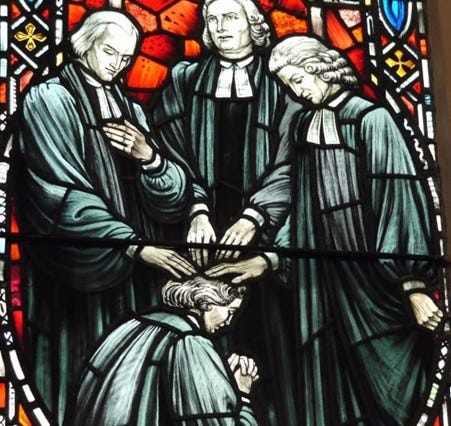
On November 14 1784, Samuel Seabury was ordained as the first American Bishop. Following the conclusion of the American War of Independence in 1783 (formally ended by the Treaty of Paris that same November), Episcopalians in Connecticut – Anglicans in North America were still known by the nomenclature of ‘the King’s Church’ – had elected one of their number to seek episcopal orders. Samuel Seabury, though not the first choice, was chosen when the preferred candidate withdrew on health grounds.
The Church of England hierarchy was politely defensive and dismissive of the American Episcopalian request. English Anglican bishops declined to help their American cousins on several grounds and placed obstacles in the way of further progress. Did Seabury have a diocese? Clearly not (yet). Did he have a Cathedral? The War of Independence had left America economically broken, and the British were still engaged in a naval blockade of the ports, so building a cathedral was hardly a priority when much of the population was starving. Would any new bishop in the former thirteen colonies swear an oath of allegiance to George III? As this loyalty to an unaccountable foreign monarch (i.e., the German king) was, in part, the point of the American War of Independence, the question seemed engineered to produce inaction.
Nonetheless, Seabury spent many, many months trying to overcome the obstacles, but to no avail. However, the Scottish Seabury’s consecration was an event of the most enormous portent. It was the first split in the global Anglican polity, and it occurred a century before the Anglican Communion could even be said to exist. Seabury was democratically elected in a republican country. There was no monarchy to defer to. This consecration of an American bishop – the first – therefore set up a tension in Anglican polity that has persisted through to the present. Is Anglicanism a democratic polity? Or is it imperialistic and monarchical in decision-making?
It was a high irony that the centre of the Jacobite Revolts between 1715 and 1745 should be Aberdeen. It was the first Scottish city to proclaim the Stuarts as rightful monarchs, and therefore the hub of rebellion against the Hanoverian monarchs. That Aberdeen should also be the city where Samuel Seabury was consecrated chimes with the revolutionary tone of the age. English Bishops declined to consecrate Seabury as he could not swear an oath of allegiance to George III. The consecration in Aberdeen – the city at the centre of the Jacobite Revolt, which is an accident, to be sure – posed a problem that looped back to events earlier that century.
After the first Jacobite rebellion, the English Parliament retaliated in 1705 with the Alien Act, imposing severe restrictions on Anglo-Scottish trade unless and until the Scottish Parliament recognised the Hanoverian lineage. The 1707 Treaty of Union was the agreement of both Parliaments to acknowledge one monarch, and form a united kingdom – the United Kingdom. This union, incidentally, created the largest free trade area and collaboration in 18th-century Europe. It was delivered mainly on English terms, primarily for the protection of English interests, and intended to maintain a Protestant government, church, state and monarch – and at the same time rule out any continental Catholic challenge.
With this in mind, the unhappy history of Whig-Tory relations with the European Union is hardly surprising, as Brexit emerged as an English-led movement not endorsed by the Scottish, Northern Irish or Welsh. As ever, the English prefer their monarchical-endorsed autonomy to the benefits of collaborative democratic federalism.
When George I came to the throne in 1714, the vast majority of Scottish Episcopalians chose to side with Edward Stuart, the son of James II, as the rightful monarch. By not recognising the reign of the Hanoverians, the Scottish Episcopalians consigned themselves to decades of marginalisation and penalisation until the death of Charles (‘Bonnie Prince Charlie’) Stuart in 1788. It is hard for 21st-century readers to grasp the full extent of the difficulties faced by Anglicans in Scotland from the 16th century through to the end of the 18th century.
Scottish Episcopalians had retained some support during the turbulence of their Reformation, and then Cromwell’s revolution. But the settlements – terms of peace, in effect – after the demise of the short-lived Republic and return of the monarchy left Episcopalians in an invidious position. Successive gestures (Acts of Indulgence) in 1693 and 1695 allowed Scottish Episcopal clergy to retain their livings if they accepted the (English) monarchy. If they were unwilling to do so, they were deposed and deprived. Around one hundred Episcopal clergy took advantage of the offer, conditional upon swearing the oath of allegiance to the new Hanoverian lineage. The remainder declined, giving rise to house churches and meeting houses comprising clergy and congregations loyal to the Stuart lineage.
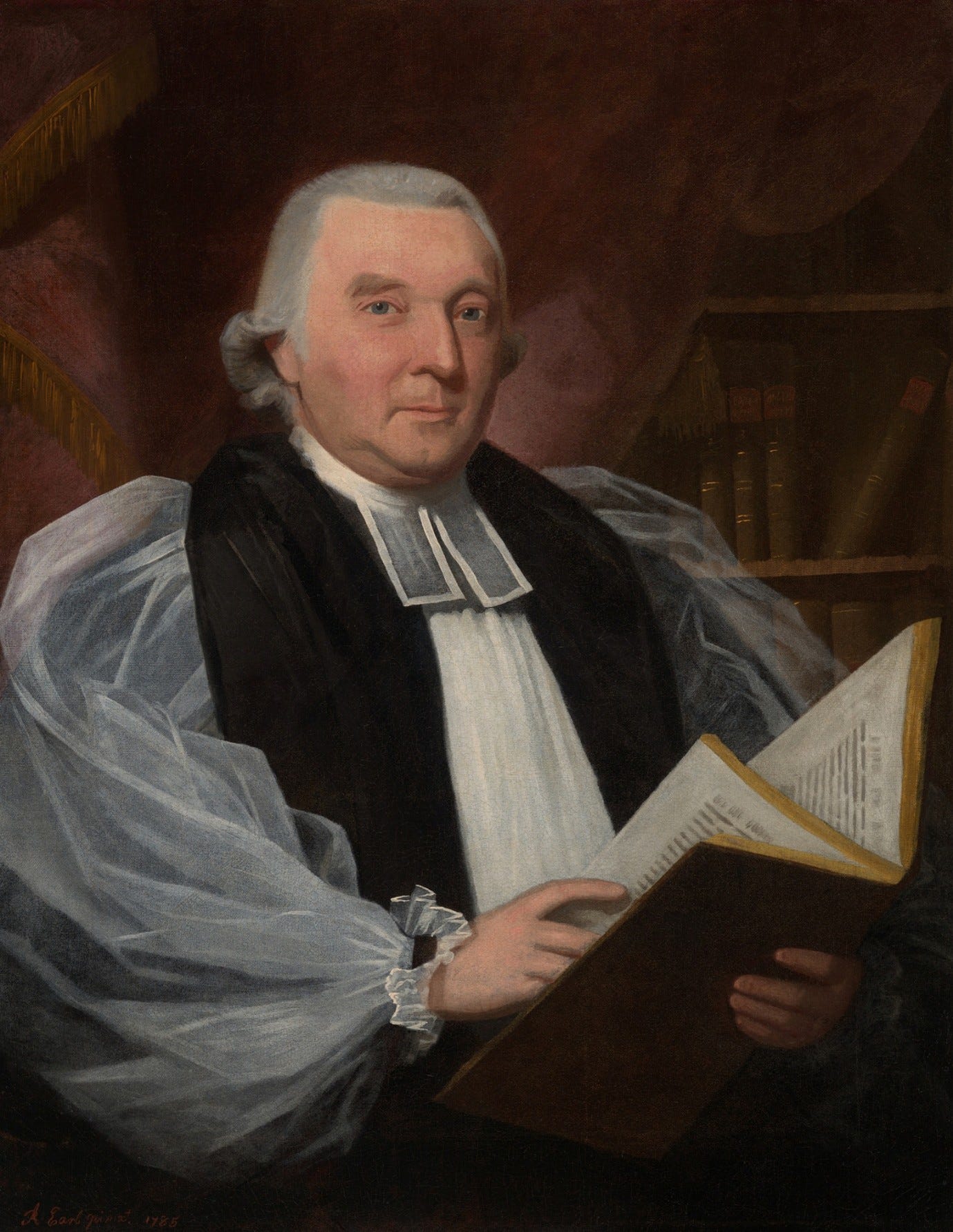
In 1719, however, any Episcopal congregation or church meeting that would not pray for the new King (George I) was closed. Episcopalian bishops dwindled in number – death and the deprivation of livings reducing their number to just one by 1720. To make matters more complicated, so-called ‘Qualified Chapels’ for Episcopalians began to emerge in Scotland. They literally did ‘qualify’, as they adopted the Church of England’s Book of Common Prayer, and their congregations were led by English or Irish Anglican clergy, loyal to the Hanoverian lineage. There may have been three dozen such congregations at their height, but the number of deprived Episcopalian congregations would have been far, far greater.
It was only in 1788, when the remnant non-juror Episcopalians refused to recognise the claim to the throne lodged by Henry Benedict Stuart on the death of Charles Stuart. The fact that Henry Stuart was also a Cardinal of the Roman Catholic Church was a bridge too far, even for Episcopalians. This was the point at which Scottish Episcopalians recognised the Hanoverian claim to the throne of a United Kingdom and offered their allegiance to George III. By 1792, Scottish Episcopalians were once again legal and able to function, perhaps for the first time in 250 years since the Scottish Reformation.
The irony is striking for the American Episcopal Church, since it rests on not one but two rebellions. The last Jacobite revolt and claim to the British throne, and the American War of Independence, with a revolution against the British throne, have helped to create an Episcopal church founded on revolt against monarchy and its claims to legitimacy, and the beginnings of a polity rooted in democracy. Although in noting this, we must bear in mind that the Jacobites were hardly democrats, since they were championing an alternative rival monarchy with very different theological sympathies.
Seabury was consecrated by three Scottish bishops who were non-jurors (i.e., did not recognise the authority of the reigning British monarch, which was hardly a problem for an American republican). But it would mean that some of the still wavering Americans who thought that British rule might be restored and the colonies revert were unlikely to receive or recognise ‘foreign’ episcopal orders.
Politically, there was fear in both Britain and America that the consecration of a bishop who was not loyal to the crown was an anti-monarchist act. It is worth bearing in mind that the French Revolution (1789-1799) was only a few years after the conclusion of the American War of Independence (1776-83). This was far closer to home for the English, and too close for comfort. The French Revolution was a period of major societal and political upheaval, which witnessed the collapse of the monarchy, the establishment of the First French Republic, and culminated in the rise of Napoleon Bonaparte and the start of the Napoleonic era. The French Revolution is one of the defining events of Western history, and the potential threat and risks it posed to English ecclesial polity cannot be understated.
Put simply, an ecclesial polity founded on monarchical establishment works differently from a democracy. The Old World order operates through paternalistic implicit means and does not need a written Constitution. Those who rule reign. The New World Order, in contrast, has a Constitution, works through explicit democratic debate, and clarity in governance.
So much for crowns. But what about mitres? Shortly after his ordination as a bishop in Aberdeen and upon returning to Connecticut, Samuel Seabury commissioned a mitre from a men’s top hat merchant in New York. Although mitres were not typically worn by Hanoverian bishops at the time, Seabury’s pro-Catholic beliefs motivated him to have one made from black beaver fur to resemble a top hat.
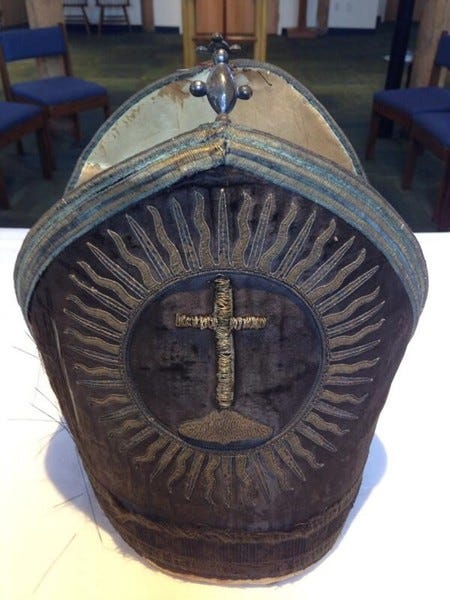
According to E. Edwards Beardsley’s Life and Correspondence of The Right Reverend Samuel Seabury, DD (Boston: Houghton, Mifflin & Co., 1881, pp. 318-319), Seabury wore the mitre during the first ordinations in the United States in 1785 and at other significant ceremonies. Seabury had tried to order an episcopal mitre in London before returning to America. This being the Hanoverian era for the Church of England, Seabury was coldly informed that none had been manufactured or tailored since the Reformation. No Hanoverian bishop wore them.
Some claim that Seabury wore his mitre like a top hat in public, given its similar design. However, I have yet to find evidence to support this. But he was the first bishop in modern Anglicanism to have a mitre. It was made out of black beaver skin. On the back crown of the mitre, in gold filigree, is sewn a crown of thorns—consistent with Seabury’s high eucharistic theology.
What is clear, however, is that Seabury was an early exemplar of the High-Church tradition that we would see in the Ritualism of the Oxford Movement some fifty years later. Some might be puzzled at the re-assemblage of liturgical provisions. For Seabury, the apostolic succession was vital for maintaining the unity of the church — one faith, but now practised somewhat differently on two continents.
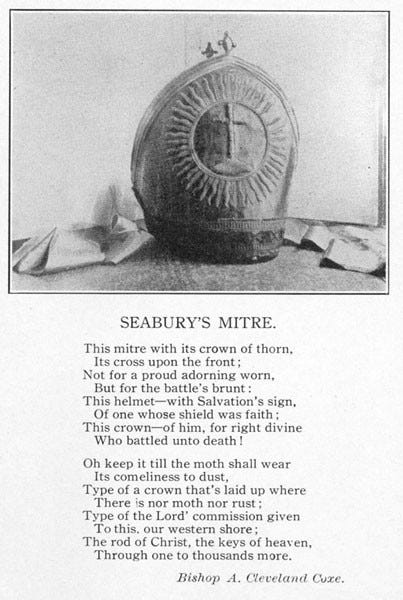
Liturgically, Seabury believed that all eucharistic celebrations were derivative of the bishop’s “celebration” of the Eucharist, and he further believed that the bishop celebrating the Eucharist completed the sacrificial act of Jesus on the cross. Seabury believed, in effect, that his cathedral was wherever he was. Dan Handschy’s article in Anglican and Episcopal History (‘Samuel Seabury’s Eucharistic Ecclesiology: Ecclesial Implications of a Sacrificial Eucharist’, March 2016, Vol. 85, No. 1, pp. 1-23) highlights an essential aspect of the story regarding Seabury’s mitre, particularly his Eucharistic theology that focuses on the sacrificial nature of Christ’s death on the cross.
Today, one might regard this as a kind of theological narcissism. But we should not be surprised at this egocentric approach to episcopacy. He might have picked some of this up from Scottish Laudian theology and the entitlement of the English episcopal establishment. When all was said and done, Seabury was a conservative monarchist who was now a bishop.
In many respects, and across the global Anglican penumbra, we are faced with the same feverish tensions of the American and French revolutions. These tensions pitch autocracy against democracy as an Old World versus New World rivalry. The revolutions of France and America were against monarchical governance and tyranny, as those who claimed to be subjects of such regimes could argue that those who reigned over them were unreliable and unaccountable, and somewhat capricious in their care for the citizenry under their rule.
Seabury’s date of birth was November 30th, St. Andrew’s Day, and the patron saint of Scotland. The Scottish flag features in a corner of the Episcopal coat of arms to remind American Anglicans of their Scottish ancestry. It is an irony that, in our time, with continued calls for Scottish independence and much afoot in English nativism, we find the tensions of 250 years ago unresolved in the 21st century, in politics and in the church.
The English Anglican bishops don’t want to be accountable to the people. They still function as quasi-monarchical officeholders, presiding over their fiefdoms much as early Saxon kings once did. General Synod is hardly evidence of democracy, and feels and functions more like a Communist assembly presided over by a bureaucratic politburo on the eve of the Berlin Wall being breached. Many now believe that an Old World autocracy cannot survive in public life (save as a symbol of the legitimate rule of law and an elected government), nor can it survive as a model of governance in ecclesial life.
The exercise of Scottish independence almost 250 years ago had far-reaching consequences for the Church of England. This remains unfinished business for the United Kingdom, the English, and the debates over devolved government. For the Church of England, however, the consecration of Samuel Seabury by the Scottish Episcopal church and its non-juror bishops represents a split in the form of governance within Anglicanism that has now become a chasm. To put it plainly, the rule of one person is a monarchy or an episcopacy. But the rule of law is a republic. The future of Anglicanism lies there.
Martyn Percy’s Church, Communion and Culture: Samuel Seabury and the Fate of Global Anglicanism, Eugene, OR: Wipf & Stock [pb] will be published in 2026.
My apologies for a late response to this post which does n excellent job of correcting some (but not all) of the Anglocentric mythology of Anglicanism. It should be read in conjunction with the Scottish Episcopal Church’s response to the Nairobi-Cairo proposals (https://www.scotland.anglican.org/wp-content/uploads/SEC-Response-to-Nairobi-Cairo-December-2025.pdf)
I myself wrote to the ACO in October lamenting the airbrushing of Celtic and Scottish Christianity :
“If one of the issues which besets the Anglican Communion is the perception that it is a fundamentally colonial institution whose history is problematic and demands a decolonisation, and, equally, that it needs to be shorn of a very much Anglo- mentality, the historical descriptions within the Proposals are both self-defeating and inaccurate.
There is painful start on page 3:
A crucial part of this story is the place of the See of Canterbury and the rich inheritance that it
represents. All Anglicans share the gospel of Jesus Christ as it was borne both to and from the
British Isles, and flourished, by the grace of God, throughout the world.
The phrasing conflates Canterbury and British. Not a good start.....One may ask historically when "Britain" exists as an historical entity for a start. With Scotland gifting England a monarch in 1603....? Before or after the Act of Union of 1707?
Page 8 is also problematic....
The history of the Anglican Communion is the story of the emergence of a family of
churches, broadly born of common parentage in England, marked by a shared inheritance
both from the Protestant Reformation and an earlier Western and Catholic patrimony. The
Elizabethan Settlement established for the Church of England a breadth of spirituality and
theology within a normative pattern of prayer and an assumed unity of faith and order, which
set the terms for subsequent Anglican identity. The era of the Anglican Communion, dating
from the first Lambeth Conference of 1867, emerged alongside a providential, unplanned
pattern of explosive missionary growth, for which the Communion has continually sought to
develop supportive structures, while protecting the autonomy of its member churches.
No mention of the Episcopalian party in Scotland, the Scottish Prayer Book of 1637, the consecration of Samuel Seabury in Aberdeen by Episcopalian, not Church of England, bishops...
Noting of course, that the conditions of Seabury's consecration meant that non-Book of Common Prayer worship would be settled on the American Church through the adoption of the Episcopal liturgical forms. SO the BCP was not the colossus that bestrode the Anglican world entirely....
Nor of the important role of the Chicago Quadrilateral (1886), two years before Lambeth... Noting the role of Bishop John Hopkins of Vermont (1851) and Canadian bishops in its inception. It is entertaining to note that not all English bishops thought it merited attendance..... "Selective" is one way of describing this....
But, wait, it gets better, The real clunker comes on p. 26
The churches of the Anglican Communion share a history of common prayer and common
mission, nourished by a rich theological inheritance. Incorporating the earliest arrival of
Christianity in Britain, Pope Gregory the Great’s sending of St. Augustine to the Angles in
the 6th century, and the reformation of the Church of England in the 16th century, what we
now call the Anglican Communion emerged gradually from the fruit of 18th, 19th, and 20th
century missions.
Would it have hurt to articulate the fact that the earliest arrivals were not just in Roman Britain, but also came from Celtic pathways via, in mainland Britain, Candida Casa (Whithorn circa 397 CE) and Iona (563 CE- I will allow you to quibble that it is not strictly "mainland", as one of the Inner Hebrides)? You will no doubt recall that the Celts coming South and the Angles going North would meet at Whitby 648 CE, under the hospitality of Hilda.
Small points, you may argue, but guaranteed to pique the ire of those who resist a predominantly English or Anglo- identity for the Anglican Communion when they see their tradition and history airbrushed out. And, make us chuckle wrily at the suggestion that the problem of colonialism is being negotiated....” ( must note that in this original I got the wrong date for Whitby…..it should read 663/664 CE)
I would suggest however that there is room for a gentle corrective here…
The first is “some support” for Episcopalianism in the 17th century. It must be noted that Episcopalianism was always strong in the North East of Scotland- and in fact in the early 17th century, it was possible, by dint of relocating the General Assembly or Synod to Perth to usher in a period of episcopal polity. (It must always be remembered that Scotland is not, and was not a homogeneous entity: the Gaelic Highlands are not the Doric North-East are not the Lalllands, not the Orkneys, or nor the Shetland Islands) . But this period of episcopal ascendancy meant the production of the 1637 prayer book and what might be called the Bishops Wars, an alternative to the completely erroneous “English Civil War” (neither English, nor civil, but another less than subtle Anglo whitewash name) given this Scottish dimension.
Second, the description of the Scottish rite, as exemplified by that 1637 book) as “Scottish Laudian theology” reveals, sadly, a return to the default Anglocentric view that Scots theology must depend on England. Here I must confess an unfair advantage- the privilege of seeing drafts of Brian Douglas’s forthcoming ”The Eucharist in Scottish Episcopalianism: An Alternative History and Theology” scheduled for publication later this year by Edinburgh University Press.
Douglas (An Australian liturgist without a dog in the usual Anglo-Scots fight and turf war) points out two important points: first the inadequacy of viewing the Kirk as essentially and only presbyterian ( a myth which is regrettably persistent, and has also been noted and resisted by Stephen M. Holmes) and, for our immediate purpose, that Scottish realist eucharist tradition may share commonalities with Laudianism, but the two are not the same, and the Scots tradition is most certainly not spawned from the English material alone.
Full recognition of this robust Scottish tradition will then further help to dismantle the global communion as English.
Seabury’s mitre merits further examination. For the symbolism described here is very much in synch with that Scots realist tradition. This should come as no suprise….given that the non-juring Scots bishops insisted that the new American church draw on their liturgical tradition to formulate their prayer book. And they did.
Again, this is important because it shatters the long, dearly and falsely held myth that the BCP is omnipresent: a sine qua non. Simply not so…. To borrow a phrase used by the former archbishop of Tanzania , Donald Mtetemela about the role of European theology as non-negotiable: “It should be consigned to the dustbin”.
Lastly, and both the SEC and Douglas note this in their respective reflections on the Nairobi-Cairo proposal, the Scots tradition makes communion the focal point of unity within a church, not simply a “baptismal ecclesiology”. It is all very well to have a common (literally) fons et origo as the baptismal ecclesiology suggests, but, to invoke a Johannine pattern, there needs to be more than a common first step: “abiding” is not satisfied simply by a common baptism (come and see, born from above) , but by a shared life which follows.
There is a wisdom in the themes from the 1985 Eucharistic Conference which was held in Nairobi and tapped into African theology: if you do not eat together, you have a problem. We cannot hope to paper over the cracks of non-communion, so profoundly recognised by generations of Scots Episcopalian theologians, by invoking a “baptismal ecclesiology”. Maybe this can be done by invoking English tradition, but not Scots….
Respectfully,
Fergus King